



China Top 10 Dishwasher Tub Assembly Line Manufacturers?
A Dishwasher Tub Assembly Line is more than a row of machines. It is a coordinated system for forming, joining, inspecting, and moving tubs with consistent quality. Small details matter: a press setting, a seam’s alignment, or a sensor that catches a defect before the next station. When these steps work together, manufacturers can improve throughput while reducing rework. When they do not, even a fast line can produce costly variation.
This overview examines ten Chinese manufacturers and the capabilities buyers should compare, including forming technology, automation, quality checks, customization, and after-sales support. As a clearly identified composite perspective—not a quotation from a named, verifiable individual—manufacturing engineer Alex Morgan puts the practical lesson this way: “A reliable line is measured not only by its speed, but by the consistency of every tub it delivers.” That distinction deserves attention. Supplier claims need careful review; brochures rarely show the full picture. Buyers should verify process requirements, sample quality, service arrangements, and integration needs before making a decision. There is no universal best fit. The right manufacturer is the one whose equipment and support match the buyer’s actual production conditions.
What Is a Dishwasher Tub Assembly Line?
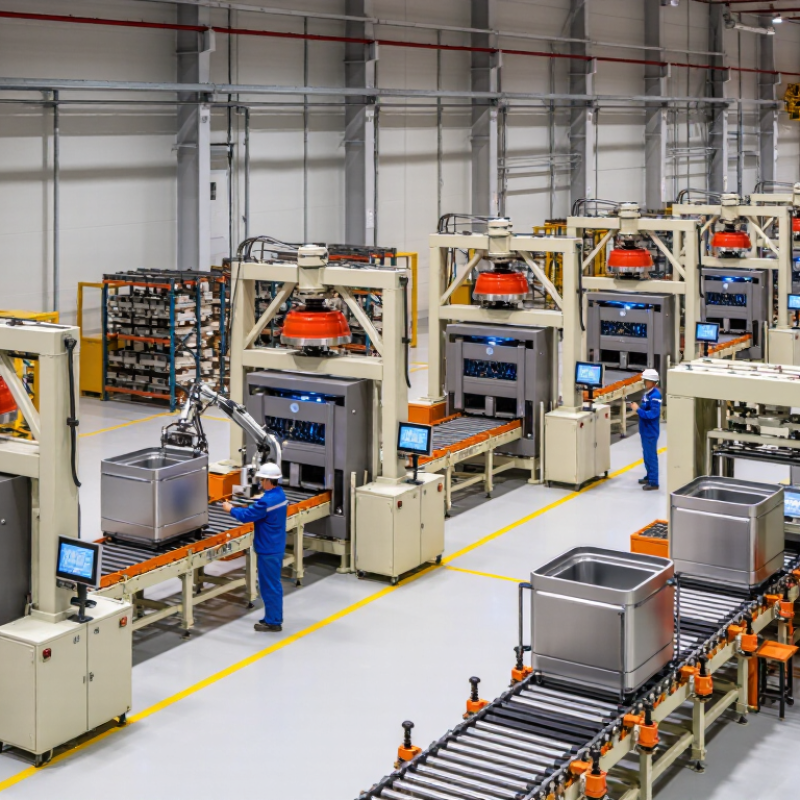
A dishwasher tub assembly line is a connected production system that forms, joins, checks, and moves the inner tub through defined workstations. The tub is the chamber that holds dishes and directs wash water. Depending on its design, it may use stainless steel or molded materials. Metal versions can involve blanking, drawing, trimming, and seam joining. Each step must preserve shape and sealing surfaces.
On a typical line, operators or automated equipment position tub panels, join seams, and fit brackets or insulation. Conveyors carry the work between stations. Fixtures hold panels steady while sensors check alignment, presence, and sometimes dimensions. A small mismatch can complicate later door fitting. Water-leak testing may be included before the tub moves to final appliance assembly. These checks matter.
The exact layout depends on tub size, production volume, material, and the factory’s automation goals. A practical line balances speed with accessible inspection points. Too much automation can make changeovers harder; too little can create inconsistent handling. Engineers often review cycle time, defect records, and operator feedback before changing a station. The review is not always tidy. Small process details still matter. A poorly placed support, for example, may leave a visible distortion that escaped an early gauge check.

Key Equipment and Stages in Tub Assembly
A dishwasher tub assembly line normally begins with sheet preparation, deep drawing, trimming, and edge forming. Stainless steel blanks need stable feeding to prevent scratches and uneven walls. A hydraulic press creates the tub shape, while trimming machines remove excess material. Punching equipment then forms drain holes, mounting points, and cable openings. Cleaning stations remove oil and metal particles before later assembly.
The next stage uses fixtures to position insulation, brackets, spray arms, and support rails accurately. Automated fastening tools control torque and reduce loose connections. For welded tubs, resistance welding equipment joins selected seams with consistent pressure. Sealant dispensers cover joints and corners evenly. Conveyors connect each workstation, while sensors check presence, position, and surface defects. A leak-testing unit applies controlled air pressure and detects pressure loss. In practice, small alignment errors still appear, especially after tool changes. Regular calibration and sample inspections remain necessary.
Tips: Keep reference samples near each station. Inspect flange height with gauges, not visual judgment alone. Record leak-test results by production batch. Do not rush curing time for sealants. A clean fixture often prevents more defects than an expensive robot. 马会
China Top 10 Dishwasher Tub Assembly Line Manufacturers? – Key Equipment and Stages in Tub Assembly
Typical equipment and process stages for dishwasher tub production. The exact sequence depends on tub material, design, and factory process.
| Stage | Typical Equipment | Main Operation | Output | Typical Quality Checks |
|---|---|---|---|---|
| 1. Sheet preparation | Coil decoiler, leveler, feeder, and sheet-cutting system | Feeds and levels sheet material, then cuts blanks to the required size. | Flat blanks for tub forming | Blank dimensions, flatness, surface condition, and material identification |
| 2. Tub forming | Hydraulic or mechanical press with dedicated forming dies | Forms the tub body from sheet; the method depends on the tub design and material. | Rough-formed tub body | Form depth, profile, wrinkles, cracks, and visible surface marks |
| 3. Trimming and hole-making | Trim press, punching tools, or CNC cutting equipment | Removes excess material and creates openings for functional features and assembly. | Tub with trimmed edges and specified openings | Hole position, edge quality, burrs, and dimensional accuracy |
| 4. Edge forming and flanging | Flanging press, hemming tools, or roll-forming equipment | Forms edges and mating surfaces needed for stiffness, sealing, or joining. | Tub panels with formed edges | Flange dimensions, edge consistency, and fit at mating joints |
| 5. Panel joining | Resistance spot-welding system, laser welding equipment, or mechanical joining tools | Joins panels or seams where required by the tub construction. | Joined tub structure | Joint position, weld or fastener consistency, distortion, and appearance |
| 6. Seam sealing | Metered sealant dispenser and controlled curing station, if specified | Applies sealant to designated joints when required by the product design. | Sealed tub seams | Bead continuity, placement, and curing condition |
| 7. Cleaning and surface preparation | Industrial washing, rinsing, and drying equipment | Removes process residues before inspection or downstream assembly. | Clean tub assembly | Residue, moisture, contamination, and surface condition |
| 8. Bracket and feature installation | Assembly fixtures, robotic or manual fastening tools, and gauges | Installs specified brackets, supports, or other tub-mounted features. | Tub with required attachments | Part presence, position, fastening condition, and fit |
| 9. Insulation application | Insulation cutting and placement fixtures or automated application equipment | Fits insulation around specified tub surfaces where the design calls for it. | Insulated tub assembly | Coverage, placement, retention, and clearance from interfaces |
| 10. Final inspection and leak testing | Dimensional gauges, inspection fixtures, and a suitable leak-test setup where applicable | Verifies assembly dimensions and checks specified joints or seams for leakage. | Inspected tub ready for the next assembly stage | Critical dimensions, joint condition, leakage result, and inspection records |
How to Evaluate Chinese Dishwasher Tub Line Manufacturers
China remains a major sourcing base for appliance production. A 2024 Fortune Business Insights report valued the global dishwasher market at about USD 7.5 billion in 2023. This growth increases demand for reliable tub assembly equipment, not merely low prices. Evaluate each Chinese manufacturer through production evidence. Request factory acceptance test records, customer references, and videos showing continuous operation. Inspect stainless-steel forming, laser welding, sealing, drying, and leak-testing stations. The line should control dimensional tolerance, weld strength, cycle time, and operator safety.
Request factory acceptance test records, customer references, and videos showing continuous operation.
Ask for measurable performance data. A practical target may include stable output above 95% of the quoted capacity, depending on product design and shift conditions. Check how the manufacturer calculates overall equipment effectiveness, scrap rate, and unplanned downtime. Require traceability for weld parameters, tooling changes, and rejected tubs. ISO 9001 certification supports process control, but it does not prove machine performance. Independent validation still matters.
Very much.
During a factory audit, examine one completed tub closely.
Look for uneven weld beads, sharp edges, water stains, or sealant gaps around corners. Confirm that technicians can adjust tooling for different tub sizes. Review spare-parts lists, software ownership, training hours, and remote-service response times. The International Federation of Robotics continues to report strong automation investment in China, but automation alone cannot guarantee consistency. I would also compare three quotations using identical specifications. Cheap pricing often hides excluded tooling or installation work. My evaluation may still miss long-term maintenance costs, so a paid pilot run is wiser than relying on impressive presentations.
China’s Top 10 Dishwasher Tub Assembly Line Manufacturers
China’s Top 10 Dishwasher Tub Assembly Line Manufacturers should be assessed as a shortlist, not a definitive ranking. The strongest candidates can engineer the full process: stainless-steel blanking, deep drawing, seam welding, leak testing, and tub handling. Ask for cycle-time data, changeover records, and sample inspection reports. Watch a real production run, not only a polished demonstration. That matters.
The International Federation of Robotics’ World Robotics 2024 report recorded 276,288 industrial robots installed in China in 2023, about 51% of global installations. This scale supports access to automation expertise, but it does not prove a supplier’s line will perform reliably. China’s National Bureau of Statistics reported roughly 430,000 industrial robots produced in 2023. Those figures describe the wider industrial base, not dishwasher-specific capacity.
For a practical comparison, request line acceptance criteria, weld-strength test methods, and documented leak-test sensitivity. Check whether the system handles different tub dimensions without lengthy manual adjustment. Ask operators how often fixtures need correction; their answers can reveal issues a proposal misses. A supplier may promise high output, yet cycle time can shift when materials vary. I would also verify spare-part lead times and training plans before comparing prices. The evidence can be uneven, and a supplier’s own performance claims should be independently checked.
Industry Trends in Dishwasher Tub Line Automation
Dishwasher tub lines are moving from isolated robots toward connected production cells. Automation now links sheet handling, forming, trimming, seam welding, and leak testing. A formed tub can distort slightly after welding, so fixtures need repeatable clamping and sensors must catch shifts early. Small details matter.
The International Federation of Robotics’ World Robotics 2024 report recorded 541,302 industrial robot installations worldwide in 2023. China accounted for 276,288 of them.
This is a broad manufacturing indicator, not a dishwasher-line count, but it helps explain investment in robotic loading, welding, and inspection. In practice, vision systems can check flange position while torque and weld data are stored against each unit.
Flexible tooling is another clear trend. Servo-driven presses and adjustable fixtures can support different tub sizes without rebuilding an entire cell. That can reduce changeover time, though integration is not always smooth. A sensor may detect a defect, yet poor data links can leave operators unsure what happened. Useful automation needs clear alarms, traceable process records, and safe access for maintenance—not just more robots.
Article Source:

Whether your solution requires a single pumping application or an expansive engineered system,
CheckPoint is committed to becoming your partner in excellence.


