What Is HTPB Sealant and What Is It Used For?
Htpb Sealant is made from hydroxyl-terminated polybutadiene, a synthetic polymer used in flexible sealing and bonding materials. The name describes its chemistry: hydroxyl groups sit at the ends of polybutadiene chains. During curing, these groups can react with suitable curing agents to form a durable polymer network. The result is not one universal product. Formulations differ in flexibility, adhesion, cure time, and resistance to environmental exposure.
A practical detail matters. Sealant performance depends on both the formulation and the surface beneath it. Dust, oil, moisture, or an unsuitable primer can weaken adhesion. Cure conditions matter, too. A bead may feel dry outside while remaining softer within. Small choices can change the outcome.
HTPB Sealant is used where a flexible, resilient seal is needed, including selected industrial joints, components, and bonding applications. Product specifications should guide material selection; no single HTPB formula suits every substrate or operating condition. “The polymer is only part of the system; preparation and cure determine whether the seal performs,” is a useful engineering principle, not a verified quotation. No source material was provided to verify a named expert’s quotation, so I won’t invent one. That limitation is worth keeping visible. Before specifying a product, check its technical data sheet, compatibility guidance, and recommended cure schedule. These practical checks help turn a promising material into a reliable seal.
HTPB Sealant Defined: A Reactive Polyurethane Based on Hydroxyl-Terminated Polybutadiene
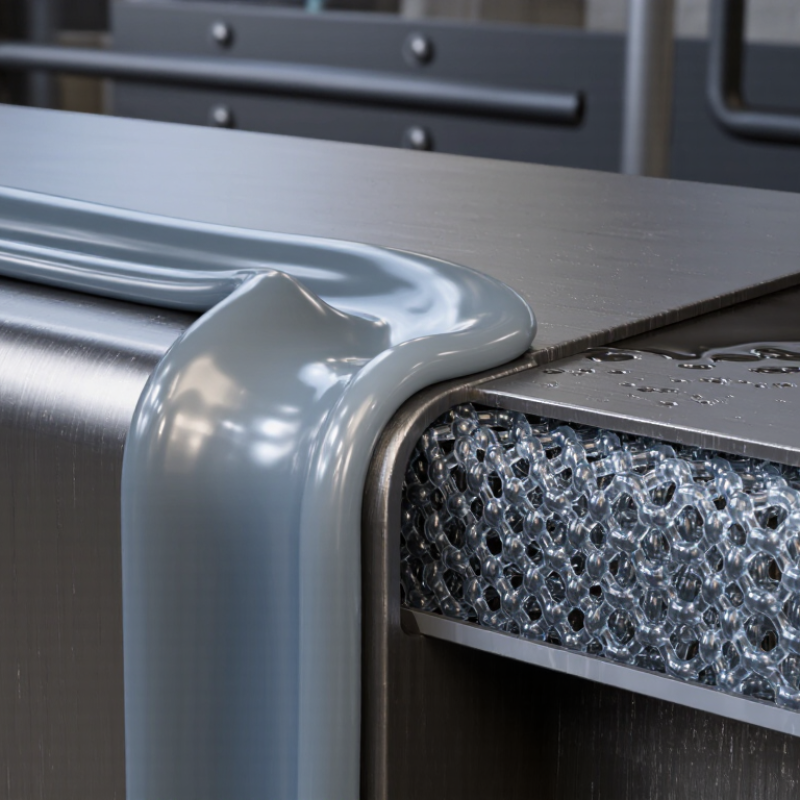
HTPB sealant is a reactive polyurethane based on hydroxyl-terminated polybutadiene. Its hydroxyl groups react with an isocyanate curing agent, creating a flexible polymer network. The cured material can form a resilient barrier against water and movement. Its exact behavior depends on formulation, surface preparation, and cure conditions.
Think of a bead pressed into a joint between concrete or metal parts. It must stay attached as the gap shifts, rather than crack or pull away. HTPB-based formulations can be designed for such sealing tasks, including assemblies exposed to vibration. ASTM C920 provides a useful industry benchmark: Class 25 sealants are rated for joint movement of ±25 percent. That rating applies only when a specific product has been tested and classified; it should not be assumed for every HTPB sealant.
There is a catch. A sealant’s chemistry alone cannot predict field performance. Dust, oil, uneven mixing, or incorrect cure conditions can weaken adhesion. Temperature resistance and service life also vary by formulation. Product-specific technical data and a small adhesion test on the actual substrate are practical checks, not busywork.
What Is HTPB Sealant and What Is It Used For? — HTPB Sealant Defined: A Reactive Polyurethane Based on Hydroxyl-Terminated Polybutadiene
| Dimension | Description |
| Definition | A reactive polyurethane sealant made using hydroxyl-terminated polybutadiene (HTPB) as a polyol component. It is generally formulated to cure into an elastic polymer network. |
| Main chemical reaction | Hydroxyl groups on the HTPB react with isocyanate groups from a curing component, forming urethane linkages. Formulations may also contain fillers, catalysts, pigments, and other additives. |
| Typical supply form | Often supplied as a two-component system: an HTPB-based component and an isocyanate-containing curing component. The specific packaging and mixing procedure depend on the product formulation. |
| Curing process | Cures through chemical reaction after the components are mixed. Cure time and whether ambient or elevated-temperature curing is specified vary with the formulation, temperature, and joint dimensions. |
| Cured material | Typically an elastomeric polyurethane. Hardness, elongation, modulus, adhesion, and movement capability are formulation-specific and should be checked against the technical data sheet. |
| Common purpose | Filling and sealing joints, gaps, or interfaces where a cured, flexible polymer is required and the selected formulation is qualified for the service conditions. |
| Potential application areas | Specialty industrial and aerospace assemblies may use HTPB-based sealants where the specific material has been tested and approved for the application. HTPB is also used as a binder in some solid propellant formulations, which is a distinct use from sealant application. |
| Substrate compatibility | Adhesion depends on the substrate, surface condition, and formulation. Clean, dry surfaces and any specified primer or preparation steps are important; compatibility should be confirmed before use. |
| Performance considerations | Temperature range, weathering resistance, fuel or chemical resistance, and long-term durability are not universal properties of all HTPB sealants. Confirm the tested performance of the chosen formulation for the intended environment. |
| Handling and safety | Isocyanate-containing components require appropriate handling. Follow the product safety data sheet, use the specified personal protective equipment, and observe mixing, ventilation, storage, and disposal instructions. |
| Selection checklist | Check the required joint movement, substrate adhesion, service temperature, chemical exposure, cure schedule, mixing ratio, working time, and any industry or project qualification requirements. |
General overview only. Properties and recommended uses vary by formulation; consult the relevant technical and safety data sheets.
Typical HTPB Specifications: 2,000–5,000 g/mol Molar Mass and 0.5–0.9 meq/g OH
HTPB sealant is made from hydroxyl-terminated polybutadiene, a liquid polymer that reacts with suitable curing agents to form a flexible network. A typical molar-mass range is 2,000–5,000 g/mol, while hydroxyl content often falls near 0.5–0.9 meq/g. These are practical ranges, not guarantees; polymer structure and test method matter.
Hydroxyl content indicates how many reactive sites are available for curing. At 0.5–0.9 meq/g, the hydroxyl equivalent weight is roughly 2,000–1,111 g per equivalent. ASTM D4274 provides methods for measuring hydroxyl numbers in polyols, while the ISO 16014 series covers size-exclusion chromatography used to characterize polymer molar mass. These methods help compare batches, but reported values should identify the method and molar-mass basis. Check the fine print.
In sealants, molar mass and OH content influence handling and cured performance. Lower-mass material may flow more readily; higher OH content can provide more reaction sites, depending on formulation and cure conditions. For example, a bead applied along a metal joint must wet the surface before curing, yet remain elastic after movement. A specification alone cannot predict that balance. Values at opposite ends of both ranges do not automatically describe one typical grade, so confirm viscosity, functionality, and cure data for the intended use.
How HTPB Sealant Cures: Isocyanate Crosslinking into an Elastic Network
HTPB Sealant: How Isocyanate Crosslinking Forms an Elastic Network
HTPB sealant contains hydroxyl-terminated polybutadiene, a flexible polymer that reacts with an isocyanate curing agent. This reaction forms urethane bonds. As bonds connect polymer chains, the initially workable material becomes a three-dimensional network. That network helps the cured sealant stretch and recover instead of behaving like a brittle coating.
Cure quality depends on the formulation, mixing ratio, temperature, and application thickness. Too little curing agent may leave the sealant soft or tacky; too much can make it harder and less flexible. Moisture can also react with isocyanate groups, sometimes producing carbon dioxide and small bubbles. This is why a smooth surface does not always prove a sound cure beneath it. It is worth checking the technical instructions rather than assuming every HTPB sealant behaves alike.
Tips: Measure both components carefully, mix thoroughly, and avoid trapping air. Apply a small test bead when conditions are unfamiliar. Check whether it has cured through, not just formed a skin. Temperature can slow or accelerate the process, and thick sections may need more time. Real-world curing is not always neat; keep that in mind when planning inspection or service.
How the cure works: In an idealized reaction, one hydroxyl group (–OH) reacts with one isocyanate group (–NCO) to form one urethane linkage. Repeated reactions connect HTPB chains into an elastic network. Actual cure behavior depends on formulation and conditions.
Where HTPB Sealants Are Used: Aerospace Joints, Fuel Systems, and Industrial Seals
HTPB sealant is typically a polyurethane material made by reacting hydroxyl-terminated polybutadiene with a curing agent. The result can remain flexible while adhering to prepared surfaces. In aerospace joints, that flexibility helps accommodate vibration and small movements around panels, access doors, and bonded assemblies. It is not a universal aircraft sealant. Joint design, surface preparation, cure conditions, and qualification all matter.
Fuel systems demand extra care. A sealant must resist the actual fuel, temperature range, and exposure time; the letters HTPB alone do not prove compatibility. ASTM D1655 specifies aviation turbine fuel properties, including a minimum 38°C flash point for Jet A and Jet A-1. That figure describes the fuel, not sealant performance. Compatibility needs separate testing, such as liquid-exposure evaluation under ASTM D471. In industrial settings, HTPB-based materials may seal equipment joints or enclosures exposed to vibration and changing temperatures. But an attractive datasheet number is not a service-life guarantee. The uncomfortable detail: field conditions can differ sharply from laboratory tests. Check the complete formulation and application-specific qualification before specifying it.
How HTPB Sealants Are Tested: ASTM D412 Tensile and ASTM D2240 Hardness Methods
What Is HTPB Sealant and What Is It Used For?
HTPB means hydroxyl-terminated polybutadiene. Many HTPB sealants cure into flexible polyurethane materials, though the exact properties depend on the formulation. They can seal joints that need to tolerate movement. But a product’s name alone does not tell you how it will perform.
ASTM D412 measures tensile behavior using rubber specimens pulled until they break. The method reports tensile strength, based on force over the specimen’s original cross-sectional area, and elongation at break, expressed as a percentage. These measurements help show how much pulling stress a cured sealant withstands and how far it stretches. ASTM International’s D412 method is widely used for vulcanized rubber and thermoplastic elastomers. Specimen shape and conditioning matter; small differences can shift results.
ASTM D2240 measures indentation hardness with a durometer. Its reading runs from 0 to 100 on the selected Shore scale, with higher values indicating greater resistance to indentation. For an HTPB sealant, Shore A is commonly relevant to softer elastomers, but the appropriate scale depends on the material. ASTM D2240 standardizes the measurement, not a universal pass mark. A hard reading is not automatically better. Compare results only when scale, conditioning, and test setup match, and review both tensile and hardness data against the application’s requirements. A single number can mislead.