



Precast Magnet technology sits at the intersection of structural engineering, factory efficiency, and construction-site safety. A Precast Magnet is a reusable magnetic fixture embedded into a steel casting table or formwork system. It holds side rails, shutters, and inserts firmly during concrete placement. Operators can release it quickly without drilling, welding, or damaging the table surface.
The global precast concrete market was valued at approximately USD 144.6 billion in 2023, according to Fortune Business Insights. The report projects continued growth through 2032, driven by modular construction, infrastructure investment, and faster production cycles. PCI technical guidance also emphasizes repeatable casting procedures, accurate form alignment, and controlled quality inspection. These demands explain why magnetic fixing systems have become increasingly practical in modern precast plants.
As precast engineer Dr. David A. Lange observes, “A reliable magnetic fixture protects both production speed and dimensional accuracy.” The principle is simple. Inside the housing, permanent magnets create strong holding force against the steel table. A release mechanism then separates the magnetic circuit when repositioning is required. No mystery there.
Yet the system is not foolproof. Rust, concrete residue, uneven steel, or an incorrectly selected pull force can reduce performance. This article examines how a Precast Magnet works, where it saves labor, and why routine inspection still matters. The overlooked detail is often the most expensive one.
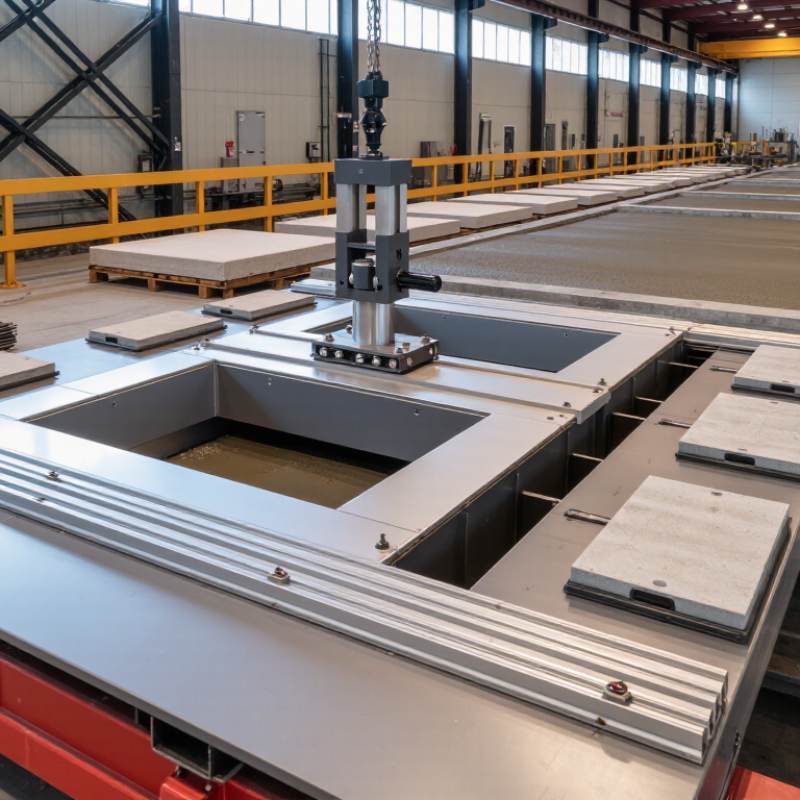
A precast magnet is a removable magnetic fixture used to secure formwork on a steel casting bed. It holds side rails, block-outs, and edge forms in position while concrete is poured and vibrated. After curing, workers release the magnet and reposition it for another mold layout.
Most units in this category provide approximately 450 to 2,100 kg of nominal pull force. This range describes the maximum vertical force under ideal contact conditions. It is not the same as a guaranteed working load. Steel thickness, surface rust, paint, gaps, and uneven contact can reduce holding strength sharply. Even a thin layer of concrete residue matters.
The magnet’s internal magnetic circuit concentrates force through its base. A mechanical switch or release lever changes the magnetic path, allowing quick activation and removal. Operators should clean the contact face before every placement and check that the form sits flat. A small air gap may be easy to miss. That is where calculations become less trustworthy.
In daily precast work, the correct size depends on form pressure, vibration, rail height, and the number of magnets used. A 450 kg unit may suit light-duty forms, while heavier layouts may require models near 2,100 kg. These figures should be verified against measured conditions, not copied blindly from a table. Some specifications look exact, but real concrete production is rarely so neat.
| Data Dimension | Typical Value or Range | What It Means | Practical Consideration |
|---|---|---|---|
| Definition | Reusable magnetic fixing unit for precast concrete formwork | A precast magnet holds a formwork profile, shuttering rail, or side form against a steel casting table without permanent drilling or welding. | It can be repositioned between production cycles and is commonly used in factory-based precast concrete manufacturing. |
| Magnetic operating principle | Switchable permanent magnet system | Internal permanent magnets create a magnetic field that passes through the bottom plate and attracts the steel casting bed. A mechanical lever or release mechanism changes the magnetic circuit. | The magnet normally holds without continuous electrical power, reducing energy use and eliminating dependence on a powered electromagnet during casting. |
| Typical pull-force range | 450–2,100 kg | The range represents commonly specified holding-force classes for different formwork sizes and loading requirements. | Pull force is normally measured perpendicular to a clean, thick steel plate. It should not be treated as the allowable working load for every installation. |
| Lower pull-force class | Approximately 450–900 kg | Suitable for lighter side forms, smaller edge profiles, and applications with moderate concrete pressure. | Verify resistance to sliding and overturning, especially when the form is tall or concrete is placed rapidly. |
| Medium pull-force class | Approximately 900–1,500 kg | Used for many general-purpose precast formwork arrangements where stronger restraint is needed. | Proper contact between the magnet base and steel table is essential; dirt, weld spatter, or gaps reduce effective force. |
| Higher pull-force class | Approximately 1,500–2,100 kg | Intended for heavier or taller formwork and applications subject to greater lateral forces. | Higher nominal force does not replace engineering checks for concrete pressure, vibration, impact, or formwork stability. |
| Main magnetic material | Permanent rare-earth or ferrite magnet assemblies | The magnetic elements provide holding force without a continuous electrical supply. | Rare-earth assemblies generally provide higher magnetic energy density, while the housing and circuit design determine the usable force at the contact surface. |
| External housing | Steel body with protected magnetic circuit | The housing protects the internal components and directs magnetic flux toward the steel casting table. | A sealed or well-protected body helps limit contamination from cement paste, water, and production debris. |
| Switching method | Mechanical lever, push-button, or integrated release mechanism | The mechanism moves or redirects the internal magnetic elements to create an ON or OFF state. | Operators should use the designated release control rather than striking the housing or forcing the lever beyond its travel. |
| Primary mounting surface | Flat steel casting table or steel formwork plate | The magnetic circuit requires a ferromagnetic surface, normally low-carbon or structural steel, to complete the flux path. | Aluminum, stainless steel grades with low magnetic permeability, wood, and concrete do not provide the same holding response as ordinary steel. |
| Common applications | Wall panels, beams, columns, slabs, stairs, and other precast elements | Magnets secure adjustable side forms, stop ends, chamfer strips, and shaping profiles during concrete placement and curing. | They are especially useful where formwork layouts change frequently or where drilling the casting table would be undesirable. |
| Effect of air gap | Holding force decreases as the gap increases | Even a small layer of concrete residue, rust scale, paint, or debris can reduce magnetic coupling. | Clean both the magnet base and the steel table before positioning; keep the contact face flat and fully seated. |
| Effect of steel thickness | Thicker steel generally improves magnetic circuit performance until saturation | A thin or highly flexible plate may not carry the full rated magnetic flux. | Rated pull-force figures should be compared only when the test plate, contact area, and test method are similar. |
| Force direction | Rated force is usually perpendicular pull force | Resistance to direct lifting is different from resistance to horizontal sliding or rotation. | For real formwork design, consider friction, lever arm, vibration, concrete placement rate, and the number and spacing of magnets. |
| Power requirement | Normally no continuous electrical power | Permanent magnets maintain holding force after activation, unlike conventional electromagnets that require energized coils. | This supports flexible production layouts and avoids accidental release caused by routine power interruptions. |
| Release and repositioning | Deactivate, lift or slide the form, then reactivate at the new position | The switchable mechanism permits rapid adjustment of formwork on the casting table. | Release only after confirming that the formwork is supported and that no suspended or unstable load is relying on the magnet. |
| Inspection points | Contact face, switch mechanism, housing, fasteners, and corrosion condition | Inspection identifies damage or contamination that may reduce holding performance. | Remove damaged units from service and verify actual holding performance according to the site’s safety procedure. |
| Key selection factors | Required force, form height, concrete pressure, table condition, magnet spacing, and operating environment | Magnet selection is a formwork engineering decision rather than a choice based only on the largest nominal pull-force number. | Use a suitable safety factor and follow applicable workplace, lifting, and precast-concrete safety requirements. |

Whether your solution requires a single pumping application or an expansive engineered system,
CheckPoint is committed to becoming your partner in excellence.